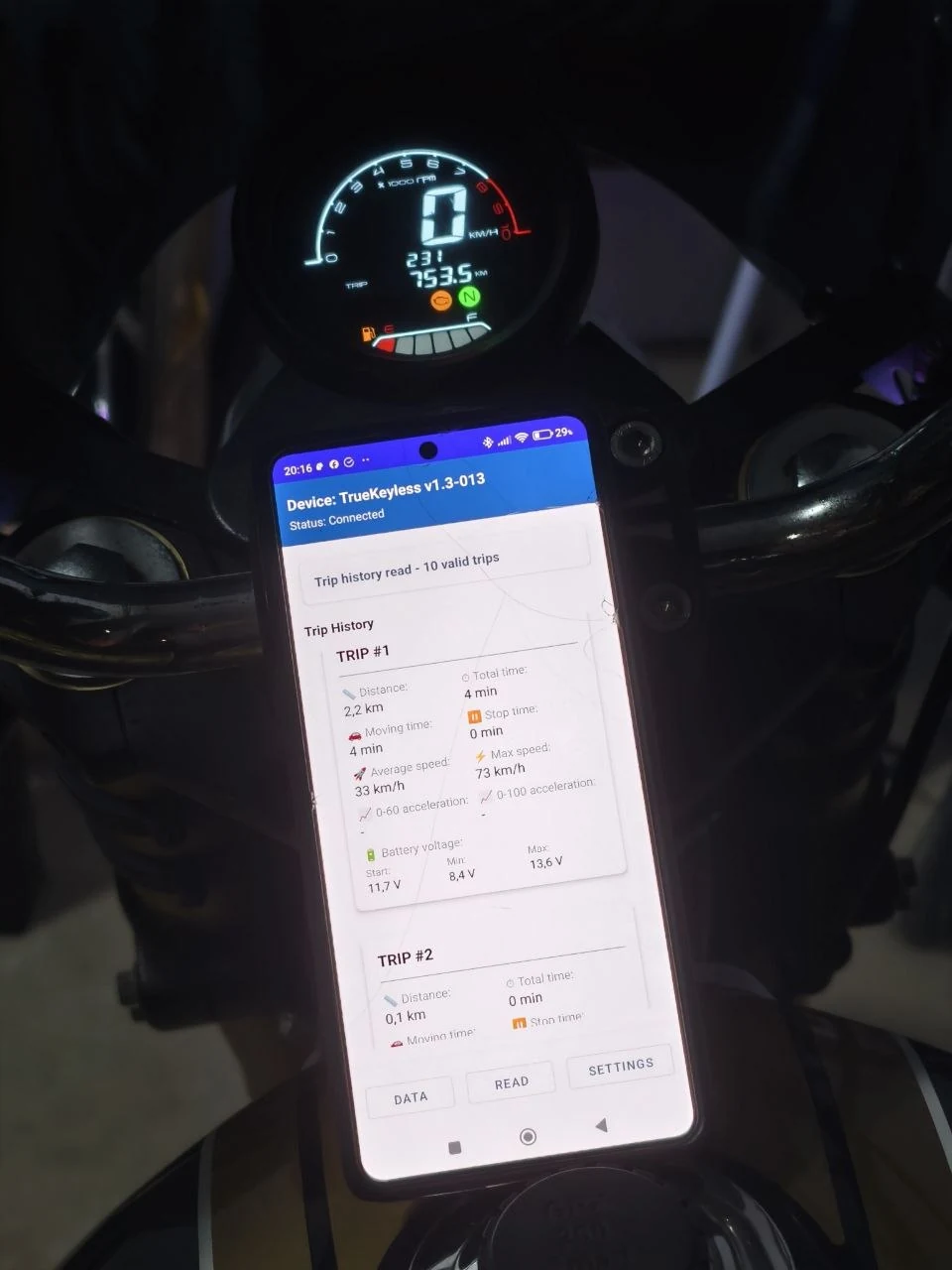
A ride, recorded on the motorcycle
The app’s trip-history view receives the last ten trip records from TrueKeylessGPX over Bluetooth. It gives me a place to review the ride after getting off the motorcycle, without needing the service app open throughout the journey.
What a trip contains
Each trip record brings together the following eleven measurements, including separate totals for time in motion and time stopped.
| Record | What it shows |
|---|---|
| Distance | Total distance travelled |
| Total time | Total trip duration, including stops |
| Moving time | Time spent in motion, shown separately from total time |
| Stop time | Time spent stopped during the trip, for example at traffic lights or in traffic. |
| Average speed | Average speed recorded for the trip |
| Maximum speed | Highest speed recorded during the trip |
| 0–60 km/h acceleration | Best recorded acceleration time from 0 to 60 km/h |
| 0–100 km/h acceleration | Best recorded acceleration time from 0 to 100 km/h |
| Battery voltage — Start | Battery voltage when the ignition turns on |
| Battery voltage — Min | Minimum battery voltage during starting |
| Battery voltage — Max | Maximum battery voltage during the trip |
Three useful battery measurements
A voltage reading means more when I know when it was taken. The trip record includes three different observations:
- Voltage when ignition turns on: context for the bike’s state after parking.
- Minimum voltage during starting: the voltage dip while the starter loads the battery.
- Maximum voltage during the trip: context for the charging system while the engine runs.
These are observations to compare over time, rather than a complete battery or alternator diagnosis on their own.
Understanding the inputs
My instrument-cluster investigation records the speed and tachometer inputs and their electrical levels. The speed signal also supports the automatic turn-signal logic. Understanding an interface once can support several useful functions.
From the road to the workbench
The photograph at the top of this page shows actual trip records on my GPX. The first visible record covers 2.2 km, with 4 minutes of moving time and no recorded stop time. Its acceleration fields show dashes rather than measured times.
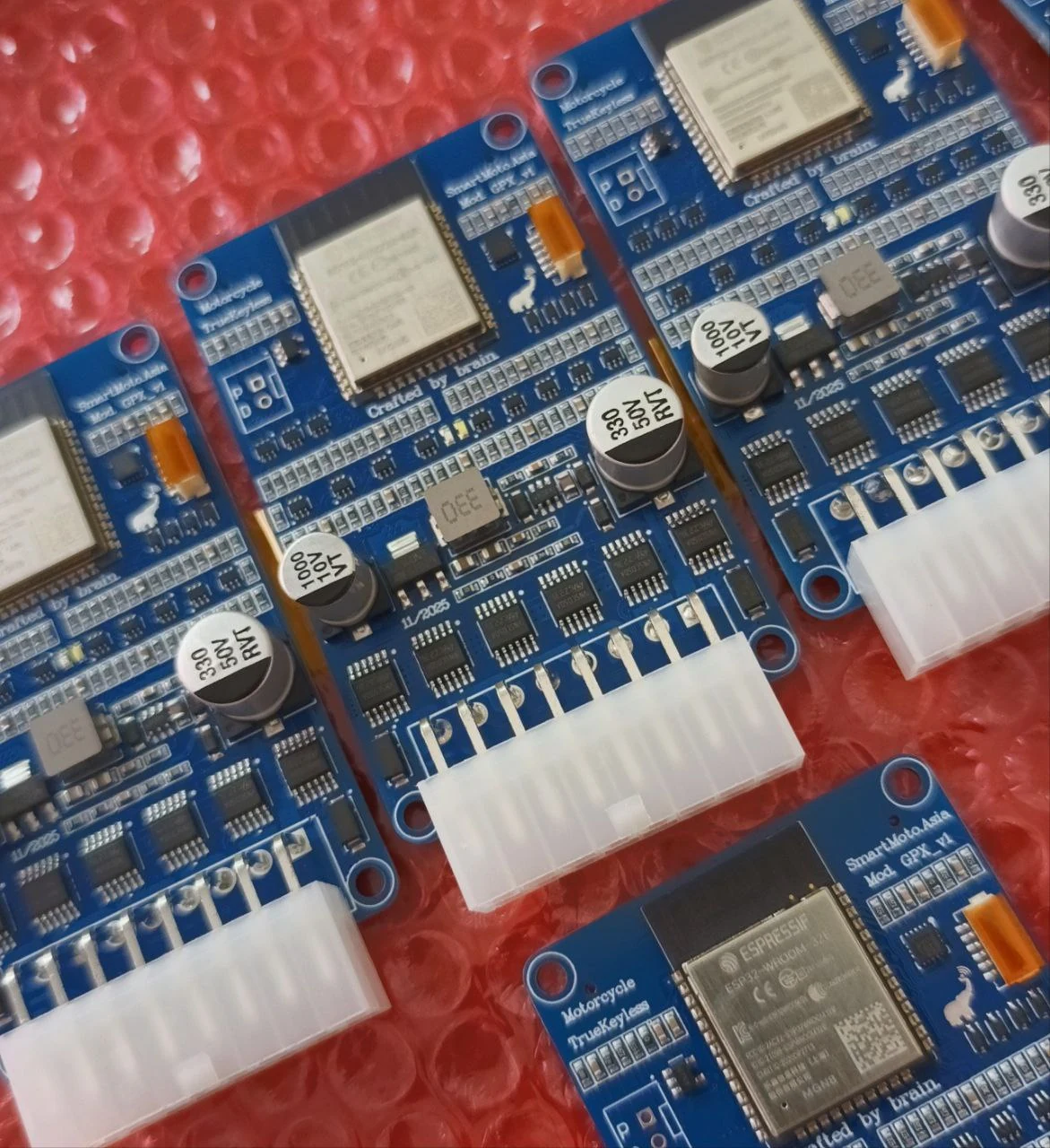
These are the boards behind that record. Trip recording is part of the same TrueKeylessGPX system that handles keyless access and turn-signal behaviour.
Operating details adapted from my TrueKeylessGPX user manual. The manual remains the reference for setup and operation.
Part of my GPX 250 Twin Brighton workshop journal.
Back to all modifications